Twitter Declares War on 3rd Party Clients

Well, it's official. Twitter has declared war on its 3rd party client developers. Ryan Sarver, Platform lead for Twitter posted a message to developers this afternoon outlining Twitter's policy change. Dave Winer reminds us all that he warned us that one day we would wish we had decentralized from Twitter. I thought he was right then, and still do. The problem is it's hard to move the community. MG Siegler, at Techcrunch, writes:

For much of the past year, the Twitter ecosystem has been in a state of flux. Ever since Twitter bought Tweetie and turned it into their own native iPhone app, third-party developers have been wondering where this would leave them. Further moves by Twitter into Android, iPad, Mac, Windows Phone, BlackBerry, and other spaces have only compounded some of this fear. So Twitter has taken some time today in their developer forum to talk a bit about the state of the ecosystem and give some guidance. It’s blunt, but necessary. Specifically, Platform lead Ryan Sarver has a fairly lengthy outline of Twitter’s line of thinking with regard to third-party clients and services. And while there’s a little bit of dancing around the topic at first, it quickly gets very clear: third-parties probably shouldn’t be creating straight-up Twitter clients any further. Sarver notes that Twitter views a “consistent user experience” as very important to them. And it’s something they’re going to hold third-party developers to a very high standard to maintain. But they don’t want them to mimic Twitter’s own experience with their native apps in order to do this. They’ve updated the API Terms of Service to reflect all of this. “Developers have told us that they’d like more guidance from us about the best opportunities to build on Twitter. More specifically, developers ask us if they should build client apps that mimic or reproduce the mainstream Twitter consumer client experience. The answer is no,” Sarver writes very matter-of-factly. “If you are an existing developer of client apps, you can continue to serve your user base, but we will be holding you to high standards to ensure you do not violate users’ privacy, that you provide consistency in the user experience, and that you rigorously adhere to all areas of our Terms of Service. We have spoken with the major client applications in the Twitter ecosystem about these needs on an ongoing basis, and will continue to ensure a high bar is maintained,” he continues. Sarver notes that according to Twitter’s own data, some 90 percent of active Twitter users now use official Twitter apps on a monthly basis to access the service. “We need to move to a less fragmented world, where every user can experience Twitter in a consistent way. This is already happening organically – the number and market share of consumer client apps that are not owned or operated by Twitter has been shrinking,” he writes. The biggest third-party client in the space is TweetDeck, which was in the process of being acquired by UberMedia when Twitter suspended their apps a few weeks ago for TOS violations. I’ve reached out to Twitter to see where TweetDeck and UberMedia stand now with the new rules. So where should third-party developers look towards in terms of developing for the ecosystem? Sarver highlights the following areas: * Publisher tools. Companies such as SocialFlow help publishers optimize how they use Twitter, leading to increased user engagement and the production of the right tweet at the right time. * Curation. Mass Relevance and Sulia provide services for large media brands to select, display, and stream the most interesting and relevant tweets for a breaking news story, topic or event. * Realtime data signals. Hundreds of companies use real-time Twitter data as an input into ranking, ad targeting, or other aspects of enhancing their own core products. Klout is an example of a company which has taken this to the next level by using Twitter data to generate reputation scores for individuals. Similarly, Gnip syndicates Twitter data for licensing by third parties who want to use our real-time corpus for numerous applications (everything from hedge funds to ranking scores). * Social CRM, entreprise clients, and brand insights. Companies such as HootSuite, CoTweet, Radian6, Seesmic, and Crimson Hexagon help brands, enterprises, and media companies tap into the zeitgeist about their brands on Twitter, and manage relationships with their consumers using Twitter as a medium for interaction. * Value-added content and vertical experiences. Emerging services like Formspring, Foursquare, Instagram, and Quora have built into Twitter by allowing users to share unique and valuable content to their followers, while, in exchange, the services get broader reach, user acquisition, and traffic. Sarver highlights Twitter’s “diverse ecosystem” of more than 750,000 registered apps. But that ecosystem definitely just got altered quite a bit today. I think that Justin Williams, iOS developer of the popular Elements app sums it up nicely: (paraphrased) "Anyone building a product around a platform in which they have no control, should be wary of the platform, especially a platform that is VC funded." My theory? It's all about the Dickbar. Twitter to users, "Here, have a Dickbar!" Users to Twitter, "We don't like the Dickbar! It covers up our timelines!" Twitter to users, "Okay, we made the Dickbar less sucky!" Users to Twitter, "But it's still a Dickbar! Fine then, we'll switch to Twitteriffic, Echofon, Tweetdeck, Hibari, etc". Twitter sees a large amount of people quit using their client. In-your-face trends ad bar plot foiled! Devises new plan... Twitter to developers, "You can't make clients anymore that don't have our 'user experience' (1)". (1): 'User Experience' = Dickbar. Brent Simmons chimes in as well:

Did Twitter just tell client-app developers to stop?

I’m seriously disappointed by this. Not as someone with a Twitter client, but as someone who likes the service and wants my fellow developers to do interesting things. One of the cool things about Twitter is that the service sparked a bunch of UI innovation on the part of some very talented client-app developers. I want to see that continue. But it’s as if they said: no more. Stop. We’ll take over now. Craig Hockenberry also makes the good point that the reason third-party Twitter clients are so important to the Twitter ecosystem is that they innovated when Twitter did not. One question though...did Twitter release this bombshell on the community on a Friday afternoon where they thought that their userbase would be distracted? On the 1st day of SXSW? On the iPad 2 launch day? I can't decide whether I think the existing news stories of the day (earthquake/tsunami, iPad 2, SXSW) will drown out the news or if SXSW will help to amplify it. I'm hoping for amplification. C'mon nerds, gather ye pitchforks and torches.

iPad: The First Year

This was Apple's promo movie as shown during yesterday's event. I cannot think of one other company that I buy products from that does such a good job of tastefully promoting its own products such as this. And although I like to scold my wife from time to time by saying "you're falling for their marketing!", when I watch this video, I do not feel that it's marketing (of course it is) because I agree with it. Let's see Microsoft, Google, Motorola or HP do that.

Steve Jobs Takes Stage To Unveil iPad 2

ipad2_title_20110302 Surprising many people with his appearance, Steve Jobs took the stage today at Apple's iPad 2 event to talk about the success of the first iPad and to announce the iPad 2. Rumors that started yesterday had suggested he might make an appearance at the event, but few thought he would do the whole presentation himself. Jobs' first bit of news was to announce that Random House was coming to the iBook store, and that to date, Apple had sold over 100 million books in the iBooks store during the first year. During this same narrative, he announced that iTunes now has over 200 million user accounts tied to credit cards. It goes without saying this is their way of saying they have 200 million potential customers in their ecosystem for developers and content providers to sell to. Job also announced that, to date, the iTunes Store has paid over over 2 billion dollars to iPhone app developers in profits. He also highlighted the stat of having sold over 100 million iPhones to date. All of this these business updates came before the big announcement of the day, iPad 2. He began his reveal of the iPad 2 by reciting a few iPad stats in its first year. Apple has sold over 15 million iPads in its first 9 months, which was more than every Tablet PC ever sold. Apple generated $9.5 billion in revenue for Apple during its first 9 month - again - April through December folks. Less than 1 year of time. Jobs was quoted to say, "and our competitors were just flummoxed." Jobs next showed a slide on screen showing the App Store has over 65,000 apps for the iPad at the time of this writing. He then displayed a slide poking fun at the Android Honeycomb tablets with the number 100 on the slide saying, "and I think we're being a little generous here." After a quick video that chronicled the first year of the iPad and is worth watching, Steve moved on to the reveal of the iPad 2. The key features are as follows: overview_gyro_20110302iPad 2 * All new design * Dramatically thinner - 33% thinner, 8.8mm down from 13.4mm (the new iPad 2 is thinner than the iPhone 4 which is 9.3mm) * Lighter - 1.3 pounds (down from 1.5 for iPad 1) * New curved sides * Comes in White or Black overview_performance_20110302* Faster - A5 Dual-core Processors * 2X faster CPU * 9X faster graphics * Same power consumption as A4 * First dual core tablet to ship in volume * Video Cameras * Front-facing camera, captures VGA * Rear-facing camera, captures 720p HD image_chip_20110302* Gyroscope * Verzion & AT&T Models Available (separate devices) * Same 10 hour battery life * Same price points as the first iPad (Wifi: $499, $599 and, $699 & 3G: $629, $729, and $829) * Ships March 11 in US * Ships March 25 internationally After finishing his list of features, he moved straight on two discuss two new accessories Apple would be releasing along-side iPad 2. The first accessory was a new HDMI adapter. This adapter is tailored for the iPad 2 but is also backwards compatible with the iPhone 4 and iPad 1. It, however, only does mirrored video output for the iPad 2. It's full feature list is as follows: overview_mirroring_20110302HDMI video out adapter * HDMI mirrored video output * Up to 1080p * Works with all apps * Supports rotation * No setup or configuration * Charge iPad 2 while using it * Priced at $39 Steve then revealed their new Smart Covers which thoroughly impressed me. If you haven't done so already, be sure to check out the demo video of Smart Covers. These new covers are designed to be ultra-light weight and very utilitarian. Using magnets, Apple insures the covers align up perfectly on the device and snap into place perfectly. If they work as well as the demo video shows, I think that they will be a treat to use. It seems as if Apple spent more time designing these covers than most iPad competitors did the exterior of their devices. Smart Cover details are as follows: overview_smartcover_gallery1_20110302 image_smartcover_20110302Smart Covers * Multi-colored * Two types of material, leather and polyurethane * Magnets grasp and auto-align it * Adds minimal weight and thickness * Micro-fiber lining cleans screen * Wake on open - sleep on close * Easy to remove or change * Polyurethane priced at $39, leather priced at $69 Next, Steve introduced Scott Forstall on stage to overview the next version of iOS, 4.3. Scott wasted no time in listing the new features of iOS 4.3: iOS 4.3 * Safari performance * Nitro JavaScript engine * iTunes home sharing * AirPlay improvements * Preference for iPad switch * Mute for rotation lock * Personal hotspot * iPhone 4 only * New apps * Photobooth (universal - free) * Facetime (universal - free) * iMovie (coming to iPad - $4.99) * Precision editor * Multitrack audio recording * New themes * AirPlay to Apple TV * Share your videos in HD * Universal app * Garageband (coming to iPad - $4.99) * Touch instruments (Grand piano, organ, guitars, drums, bass) * Guitar amps and effects * 8 track recording and mixing * 250+ Loops * Email ACC file of your song * Compatible with Mac version overview_chicklet_garageband_20110302overview_chicklet_imovie_20110302overview_facetime_icon_20110302overview_photobooth_icon_20110302Scott, Steve, Randy Ubillos (Chief Architect, Video Applications), and Xander Soren (Director of Music Marketing) showed off demos of each of these apps in succession. Again, if you want to see them in action, check out their demos during the Keynote itself. I think the improvements to iPad are killer. One of my problems with editing videos on iPhone 4 was due to the fact that the screen was so small it made video editing difficult. iMove on iPad 2 looks absolutely killer. I'm more of a still photography enthusiast myself, however I have the urge to try to make a nice movie on the iPad. Am I going to buy one? Because my wife will likely read this, probably not.[^1] [^1]: Is she gone now? Okay, good...yeah, I'll probably get one.

This American Life Discovered Coke Secret Formula

Maybe, perhaps, but the episode is well worth listening to. As Jason Kottke puts it, "I've never heard Ira Glass quite so on-the-edge-of-his-seat giddy."coke-recipe

The formula for Coca-Cola is one of the most jealously guarded trade secrets in the world. So we were surprised to come across a 1979 newspaper article with what looked like the original recipe for Coke. Talking to historian Mark Pendergrast, author of For God, Country and Coca-Cola, we were even more surprised when we found reasons to believe the recipe is real.

If you'd like to mix up your own batch of Coca-Cola, here's the original recipe and instructions.

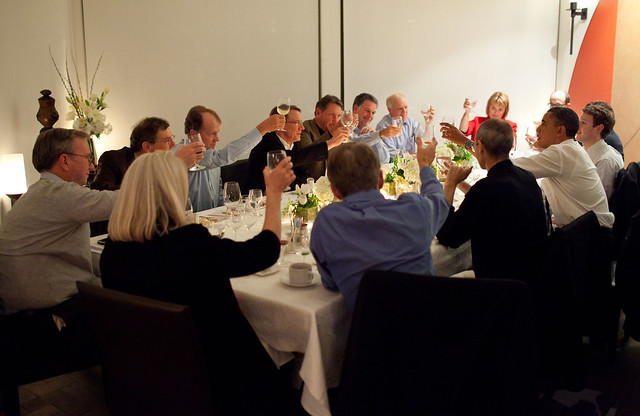
Photo: President Obama meets with Tech Luminaries

President Barack Obama joins a toast with Technology Business Leaders at a dinner in Woodside, California, Feb. 17, 2011.

Here’s the full list of attendees according to the NY Times, LA Times and SF Chronicle:

  • John Doerr, partner, Kleiner Perkins Caufield & Byers
  • Carol Bartz, president and CEO, Yahoo!
  • John Chambers, CEO and chairman, Cisco Systems
  • Dick Costolo, CEO, Twitter
  • Larry Ellison, co-founder and CEO, Oracle
  • Reed Hastings, CEO, NetFlix
  • John Hennessy, president, Stanford University
  • Steve Jobs, chairman and CEO, Apple
  • Art Levinson, chairman and former CEO, Genentech
  • Eric Schmidt, chairman and CEO, Google
  • Steve Westly, managing partner and founder, Westly Group
  • Mark Zuckerberg, founder, president and CEO, Facebook

Going around the circle, starting from the President's right: Mark Zuckerberg, Unknown, Dick Costolo, Carol Bartz , John Hennessy, Reed Hastings, Larry Ellison, John Doerr, John Chambers, Art Levinson, Eric Schmidt, Unknown, Steve Westly, and Steve Jobs.

P021711PS-0705

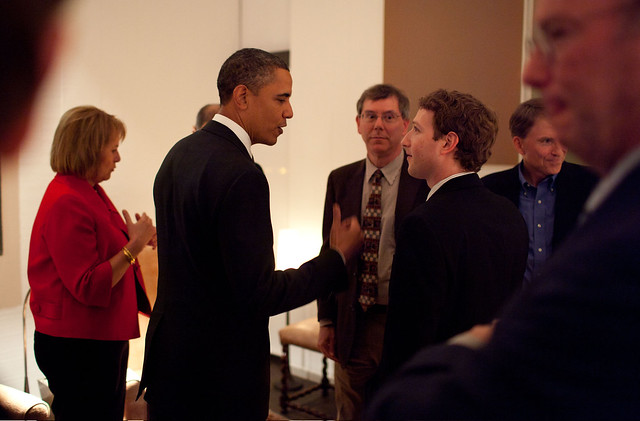
Also posted to the official White House Flickr account, a photo of the President speaking with Mark Zuckerberg.

P021711PS-0659