The Making of Star Wars: The Empire Strikes Back

Empire Strikes Back Filming

Vanity Fair takes a look at the new book The Making of Star Wars: The Empire Strikes Back by J. W. Rinzler.

Out this month, the slick coffee-table tome The Making of Star Wars: The Empire Strikes Back chronicles the complete tale—from pre-release to blockbuster success—of what’s become the fan favorite of the Star Wars series. Released in 1980, George Lucas’s Episode V pushed the boundaries of special effects and left audiences with one of cinema’s most epic cliffhangers.

via Daring Fireball

Back Home

I took several pictures on both my Canon 40D and my iPhone 4 while down at my grandparent's place in southern Virginia this past weekend. It was my grandfather's 85th birthday. While there, I walked out behind the house to snap a few photos on both the DSLR and iPhone. I was particularly pleased with how this specific photo, taken on my iPhone 4, turned out. I've not edited this photo in any way.

Click though to see a blown up version of this image.

http://farm5.static.flickr.com/4154/5072799364_925f8377d6.jpg

Lets see your Blackberry/Droid/Windows Phone 7 do that.

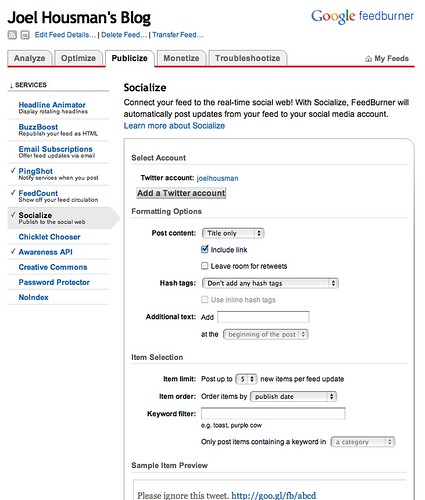
PSA: Tired of Twitterfeed intermittently working? Use Feedburner Socialize instead.

Feedburner Socialize

For about 2 years now I've been using this 3rd party site, Twitterfeed, to auto tweet my blog posts to my Twitter account. On paper, the site looks great, but in practice, it works poorly and lacks certain features. It can only poll my blog every 30 minutes, at the most frequent setting, for new posts. Despite this setting, sometimes several hours go by after I post before it auto-Tweets the link. Additionally, sometimes it fails to do it at all.

When this happened today, around lunchtime, I finally decided to seek out an alternative. Little did I know that a far superior solution was sitting right in front of me this whole time, and I could have EASILY been using it.

Like many bloggers, I use Feedburner to re-host up my RSS feed for my site because of the greatly increased functionality and control it gives me over my RSS feed. You can do things such as insert code into each blog post (google ads, etc), get detailed analytics on your feed subscribers, and it gives you capabilities like PubSubHubBub.

A quick Google Search for "Twitterfeed Alternative" turned up this blog post from ThinkSplendid, which covered exactly what I was looking for. Apparently, and I did not know this, Feedburner has had the built-in capability of publishing blog post links/summaries to Twitter for some time now. You can find this functionality under the "Publicize" tab -> "Socialize" side-nav link. It does EXACTLY what Twitterfeed does, but with the added reliability of The Google™. What's even better: instead of polling my site every 30 minutes for new posts, it will post a Tweet whenever a new post shows up in my RSS feed - instantly - because my CMS, Squarespace, is PubHubSubBub compatible. Yes, I know this is a very first world problem to have, but it just made my Monday.


Microsoft's Language Problem

John Gruber points out something related to the launch of the Windows Phone 7 category of phones this morning:

Microsoft announces Windows Phone 7, in a press release headlined “Windows Phone 7: A Fresh Start for the Smartphone: The Phone Delivers a New User Experience by Integrating the Things Users Really Want to Do, Creating a Balance Between Getting Work Done and Having Fun”:

The goal for Microsoft’s latest smartphone is an ambitious one: to deliver a phone that truly integrates the things people really want to do, puts those things right in front of them, and either lets them get finished quickly or immerses them in the experience they were seeking.

Who talks like this? This bureaucrat-ese is intended, I suppose, to sound serious. But it just sounds like bullshit.

Here’s how Steve Jobs introduced the iPhone in 2007:

Today Apple is going to reinvent the phone. And here it is.

Experiment: Town in England turns off traffic lights, surprising results.

Interesting video of a small town in England that was experiencing chronic traffic backup due to a bad intersection which has a long delay on its traffic lights. The local government tried an experiment where they turned off the traffic lights for a few days to see what would happen. The results surprised a lot of local residents.

Go watch the video (sorry, not embeddable)