
McCain Warns Of "Hard Struggle" On The "Iraq-Pakistan Border"
Today on Good Morning America, Sen. John McCain (R-AZ) refused to call the situation in Afghanistan “precarious and urgent,” but admitted that “We have a lot of work to do.” He warned of a “very hard struggle, particularly given the situation on the Iraq-Pakistan border.” Watch it:
Of course, Iraq is nowhere near Pakistan. In fact, Baghdad — the capital of Iraq — is over 1,500 miles from Pakistan’s capital of Islamabad:

Before McCain repeats his claim to “know how to win wars,” he should probably look at a map.
Bush Administration Caught Pressuring Iraqi Govn't to Mislead Americans to help McCain
The New York Times acquired and translated Der Spiegels' recording of al Maliki's interview. It confirms the original story. Al Maliki said:
“Obama’s remarks that — if he takes office — in 16 months he would withdraw the forces, we think that this period could increase or decrease a little, but that it could be suitable to end the presence of the forces in Iraq.”
“Who wants to exit in a quicker way has a better assessment of the situation in Iraq.”
Bush just got caught pressuring Iraq's government to mislead Americans to help McCain.
New York Times article is below:
BAGHDAD — On the eve of Senator Barack Obama’s visit to Iraq, itsprime minister tried to step back Sunday from comments in an interview in which he appeared to support Mr. Obama’s plan for troop withdrawal.
The interview with the prime minister, Nuri Kamal al-Maliki, was published Saturday in the online version of Der Spiegel, a German magazine. It was widely picked up by American newspapers because it appeared to give an unexpected boost to Mr. Obama, the presumptive Democratic presidential nominee, who has called for an expedited withdrawal.
Mr. Obama arrived in Baghdad on Monday, according to Reuters, for meetings with American military commanders and Iraqi officials. He had made an overnight stop in Kuwait, where he met with the emir, Sheik Sabah al-Ahmed al-Sabah, according to a Kuwait government news agency.
Mr. Maliki's interview prompted immediate concern from the Bush administration, which called to seek clarification from Mr. Maliki’s office, American officials said.
Scott M. Stanzel, a White House spokesman with President Bush at his ranch in Crawford, Tex., said that embassy officials explained to the Iraqis how the interview in Der Spiegel was being interpreted, given that it came just a day after the two governments announced an agreement over American troops.
“The Iraqis were not aware and wanted to correct it,” he said.
The back-and-forth between the governments came as Mr. Obama finished a one-day trip to Afghanistan, where he met with President Hamid Karzai for nearly two hours on Sunday. Mr. Obama said the United States, NATO and Afghanistan must step up their efforts to fight the Taliban and Al Qaeda and to encourage Pakistan to eliminate terrorist training camps.
“Our message to the Afghan government is this: We want a strong partnership based on ‘more for more’ — more resources
from the United States and NATO, and more action from the Afghan government to improve the lives of the Afghan people,” Mr. Obama said in a written statement, which was also signed by Senators Jack Reed, Democrat of Rhode Island, and Chuck Hagel, Republican of Nebraska, who are part of the traveling American delegation.
Mr. Obama, who is on the opening leg of a weeklong overseas trip, said in a television interview that the United States needed to send a stronger message to Pakistan about its efforts to fight terrorism along its border with Afghanistan.
“I think that the U.S. government provides an awful lot of aid to Pakistan, provides a lot of military support to Pakistan,” Mr. Obama said on “Face the Nation” on CBS. “And to send a clear message to Pakistan that this is important, to them as well as to us, I think that message has not been sent.”
In Iraq, controversy continued to reverberate between the United States and Iraqi governments over a weekend news report that Mr. Maliki had expressed support for Mr. Obama’s proposal to withdraw American combat troops within 16 months of January. The reported comments came after Mr. Bush agreed on Friday to a “general time horizon” for pulling out troops from Iraq without a specific timeline.
Diplomats from the United States Embassy in Baghdad spoke to Mr. Maliki’s advisers on Saturday, said an American official, speaking on condition of anonymity in order to discuss what he called diplomatic communications. After that, the government’s spokesman, Ali al-Dabbagh, issued a statement casting doubt on the magazine’s rendering of the interview.
The statement, which was distributed to media organizations by the American military early on Sunday, said Mr. Maliki’s words had been “misunderstood and mistranslated,” but it failed to cite specifics.
“Unfortunately, Der Spiegel was not accurate,” Mr. Dabbagh said Sunday by telephone. “I have the recording of the voice of Mr. Maliki. We even listened to the translation.”
But the interpreter for the interview works for Mr. Maliki’s office, not the magazine. And in an audio recording of Mr. Maliki’s interview that Der Spiegel provided to The New York Times, Mr. Maliki seemed to state a clear affinity for Mr. Obama’s position, bringing it up on his own in an answer to a general question on troop presence.
The following is a direct translation from the Arabic of Mr. Maliki’s comments by The Times: “Obama’s remarks that — if he takes office — in 16 months he would withdraw the forces, we think that this period could increase or decrease a little, but that it could be suitable to end the presence of the forces in Iraq.”
He continued: “Who wants to exit in a quicker way has a better assessment of the situation in Iraq.”
Mr. Maliki’s top political adviser, Sadiq al-Rikabi, declined to comment on the remarks, but spoke in general about the Iraqi position on Sunday. Part of that position, he said, comes from domestic political pressure to withdraw.
“Foreign soldiers in the middle of the most populated areas are not without their side effects,” he said. “Shouldn’t we look to an end for this unhealthy situation?”
Administration officials expressed confidence on Sunday that Mr. Maliki did not intend to create a rift with Mr. Bush on the issue of withdrawals, saying that both leaders conditioned any troop pullout on improved security in Iraq and would not impose a rigid timetable.
But a senior military official in Iraq said top American commanders expressed surprise and confusion over Mr. Maliki’s published remarks. The official added, however, that no American officers spoke to the Iraqi prime minister or any of his top aides about them.
“This isn’t the first time this has happened with the prime minister,” said the senior military official, noting that Mr. Maliki or his top aides had had to issue clarifications previously of comments that Iraqi or foreign journalists reported the prime minister said. “All of us were going, ‘What? What did he say, why did he say it and was it accurate?’ ”
Mr. Obama’s movements remained shrouded in secrecy, but Iraqi officials said he was scheduled to meet with Mr. Maliki on Monday before the prime minister was to travel to Germany and also with President Jalal Talabani. Americans here strictly warned Iraqi officials not to give details about Mr. Obama’s visit.
Before leaving Afghanistan, Mr. Obama shared a traditional Afghan lunch of chicken, mutton and rice during a meeting with Mr. Karzai. An Afghan government spokesman, Homayun Hamidzada, said the meeting was conducted in a “very friendly environment.”
Mr. Hamidzada made light of Mr. Obama’s earlier criticism of Mr. Karzai as not getting out of his bunker enough to help Afghanistan develop, saying it was not so much a criticism as a statement of realism.
“While we are making progress, we are also facing the significant threat of terrorism that is imposed upon us and on the Afghan people,” he said.
“We are spending a lot of time and resources on fighting terrorism,” he said, adding that the government hoped in the future to spend more of those resources on the development of Afghanistan.
HDR Photograph of a SR71 Blackbird
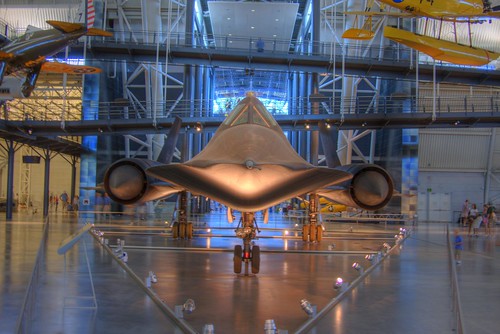
Pics of the SR71 Blackbird taken at the Smithsonian Air & Space Museum at the Dulles expansion. I shot 3 exposure bracketed images on my Canon 40D and I then used Photomatix Pro to convert them into an HDR image that has been tonemapped. Quite pleased with how this turned out.


Update: Murky Coffee Fiasco makes the Washington Post Metro Section
Article here, quoted below:
Espresso, Extra Bitter
Man's Tiff With Barista Spills Onto Internet
By Joe Heim
Washington Post Staff Writer
Thursday, July 17, 2008; B01Who knew a cup of coffee could create such a tempest in a teapot?
Not Jeff Simmermon, whose request for a triple shot of espresso over ice at Murky Coffee in Arlington County turned into a heated Internet squabble, sparked debate about whether the customer is always right and provided a reminder about the intended and unintended consequences of blogging.
The drink request Sunday, said Simmermon, who was visiting from Brooklyn, was denied by a barista who told him that Murky doesn't do espresso over ice. Irked, Simmermon said he asked for a triple espresso and a cup of ice, which he said the barista provided, grudgingly.
Service. No smile.
Then -- and this is Simmermon's account -- the barista scolded him, saying that what he was doing to his espresso was "not okay" and that the store's policy was to preserve the integrity of the drink. The employee said that allowing customers to dilute espresso was not in keeping with said policy.
Coffee-rage moment in 3, 2, 1 . . .
Simmermon, 32, said that he interrupted the barista with an angry blast about how he would have his coffee any way he pleased, thank you very much, and that he told the barista he had his own policy about doing what he wants with the products he pays for. He mixed in a couple of expletives, but that was the essence of it.
That might have been the end of the saga, but Simmermon did what comes naturally to literate victims of perceived everyday injustices in the 21st century.
He blogged about it.
In a post on his Web site, And I Am Not Lying For Real ( http://andiamnotlying.com), Simmermon detailed the encounter, his anger and, somewhat befuddlingly, his order at Murky an hour later for the "strongest iced beverage your policy will allow." He accepted the barista's recommendation for an Americano with four shots "and light on the water." (He said he enjoyed it.)
He also posted a picture of the dollar bill he left as a tip, on which he wrote "[naughty word deleted] you and your precious coffee policy."
Since coffee shops are little more than way stations and IV drips for many bloggers, it's not surprising that Simmermon's post quickly made the rounds in cyberspace. Murky's owner, Nicholas Cho, was alerted to the dispute and responded with an open letter on the cafe's Web site ( http://murkycoffee.com). He defended his berated barista, David Flynn, and ticked off a litany of store policies that would have made Seinfeld's Soup Nazi duck for cover:
"No modifications to the Classic Cappuccino. No questions will be answered about the $5 Hot Chocolate (during the months we offer it). No espresso in a to-go cup. No espresso over ice. These are our policies. We have our reasons, and we're happy to share them."
At his cafe yesterday, Cho explained the policy: "The way we do espresso is different than what people are used to. It's a very exacting technique. . . . When you pour it over ice, it creates a certain acidic reaction that makes the drink sour."
He also said some customers have the audacity to order an espresso over ice, then fill the glass with milk at the dairy bar -- creating their own iced latte, at a significant saving.
In his letter on Murky's site, Cho wrote: "To others reading this I will say that if you don't like the policies, I respectfully recommend that you find some other place that will give you what you want, or select something that we can offer you."
But regarding Simmermon, who said in his post that he would only return to Murky Coffee "carrying matches and a can of kerosene," Cho's anger was undiluted.
"While I certainly won't bemoan you your right to free-speech," he wrote, "I have to respond to you in your own dialect: [naughty word deleted] you, Jeff Simmermon. Considering your public threat of arson, you'll understand when I say that if you ever show your face at my shop, I'll punch you in your [another naughty word deleted]."
Whew. Decaf anyone?
The battle of the blogs escalated, and a cabal of caffeinated commenters soon weighed in.
On a typical day, Murky's Web site receives 200 visits. On Tuesday, there were more than 15,000, Cho said yesterday. His e-mail inbox was filled with messages full of vitriol and praise.
Simmermon said his post about l'affaire Murky drew record hits for him, too -- 100,000, at last count.
But yesterday, he expressed regrets.
"I have mixed feelings about it, and I'm not really proud of the behavior that triggered this," he said. "These things take on a life of their own, and I don't want to be a part of it. He had a bad day, the owner had a bad day, and I had a bad day. That's all."
Cho is also ready to move on, if not exactly back down.
"You have to fight blog with blog," Cho said with a laugh. "That's the price you pay when you throw your words out there."
Cho and Simmermon seemed astounded at the amount of commentary the postings received.
"Ultimately, it's just coffee," Cho said.
Exactly. Can't we all just get a latte?

Furthermore, Cho makes another followup response on the company's blog, claiming that the majority of the comments left on the previous two posts were supportive, but then, the majority of the comments left on the current post appear to be negative. Also - the VAST MAJORITY of the Washginton Post commenters are also negative, all supporting the customer. It looks like this has indeed turned out horribly for Cho, not surprisingly.