The FCC Needs To Listen To Google

I was very pleased to see Google publicly wade into the upcoming FCC auctions for the 700MHz spectrum that will occur early next year. Should all go well, the new spectrum could be used to create a new open-access wireless broadband “pipe” into people’s homes and devices. If things go less well, the existing wireless giants would buy the spectrum and impose similar usage restrictions that exist on cellular networks in the U.S. today, putting us further behind Europe and Asia.


CEO Eric Schmidt sent a letter to FCC Chairman Kevin Martin stating that they would commit to bid at least $4.6 billion in the auctions if four key platform rules are adopted. These rules will define what types of services the winner could offer, and would require third party access to the bandwidth:


  1. Open applications: Consumers should be able to download and utilize any software applications, content, or services they desire;


  2. Open devices: Consumers should be able to utilize a handheld communications device with whatever wireless network they prefer;

  3. Open services: Third parties (resellers) should be able to acquire wireless services from a 700 MHz licensee on a wholesale basis, based on reasonably nondiscriminatory commercial terms; and

  4. Open networks: Third parties (like internet service providers) should be able to interconnect at any technically feasible point in a 700 MHz licensee’s wireless network.


Given the sorry state of the mobile landscape in the U.S., I’d expect the FCC to adopt these pro-consumer rules without any fuss. But the incumbent players, including AT&T and Verizon, are saying they are opposed to open access and may not participate if these rules are adopted. Google’s public move was made to let the FCC (and the public) know that there are companies very happy to bid in an open-access world.


AT&T’s response to Google’s letter was breathtaking in its audacity:


Not satisfied with a compromise proposal from Chairman Martin that meets most of its conditions, Google has now delivered an all or nothing ultimatum to the U.S. Government, insisting that every single one of their conditions “must” be met or they will not participate in the spectrum auction. Google is demanding the Government stack the deck in its favor, limit competing bids, and effectively force wireless carriers to alter their business models to Google’s liking. We would repeat that Google should put up or shut up— they can bid and enter the wireless market with any business model they prefer, then let consumers decide which model they like best.


For anyone who doesn’t look too closely at the issue, AT&T’s response seems very reasonable: keep government regulation out of the spectrum let the market decide which services win. But that isn’t really what would happen at all. If fewer government restrictions are placed on the bandwidth the auction winners will be able to extract more profits at the expense of competitors and consumers. So naturally they don’t want to see open access rules like those recommended by Google. The incumbents also don’t want to see Google play in their sandbox and bidding against them - so they have yet another reason to oppose their proposal.


The FCC has competing goals of maximizing revenue from the auction (suggesting less regulation) and protecting the public (suggesting more rules to force competition). Having open access requirements like those suggested by Google will spur competition and grow an economy around this spectrum. It will also put commercial pressure on mobile operators and broadband companies to reduce the restrictions they have on current broadband and mobile services.


Google isn’t always not evil, but in this case they are going to bat for all of us against some players with pretty bad history when it comes to offering consumer products. I’m behind them on this. And to the FCC: please learn from past mistakes, ignore the lobbyists this time, and do what is in the best interests of the public.

(Via TechCrunch.)

Learning from Dave Winer


Even if you never read a single thing Dave Winer wrote in his 439 years of blogging, it's worth taking time to study his ideas about comments on blogs (he doesn't allow them).


"...to the extent that comments interfere with the natural expression of the unedited voice of an individual, comments may act to make something not a blog.... The cool thing about blogs is that while they may be quiet, and it may be hard to find what you're looking for, at least you can say what you think without being shouted down. This makes it possible for unpopular ideas to be expressed. And if you know history, the most important ideas often are the unpopular ones.... That's what's important about blogs, not that people can comment on your ideas. As long as they can start their own blog, there will be no shortage of places to comment."


The important thing to notice here is that Dave does not see blog comments as productive to the free exchange of ideas. They are a part of the problem, not the solution. You don't have a right to post your thoughts at the bottom of someone else's thoughts. That's not freedom of expression, that's an infringement on their freedom of expression. Get your own space, write compelling things, and if your ideas are smart, they'll be linked to, and Google will notice, and you'll move up in PageRank, and you'll have influence and your ideas will have power.


When a blog allows comments right below the writer's post, what you get is a bunch of interesting ideas, carefully constructed, followed by a long spew of noise, filth, and anonymous rubbish that nobody ... nobody ... would say out loud if they had to take ownership of their words. Look at this innocent post on a real estate blog. By comment #6 you're already seeing complete noise. By #13 you have someone cursing and saying "go kill yourself." On a real estate blog. #18 and #23 have launched into a middle eastern nuclear conflageration which continues for 100 posts. They're proving John Gabriel's Greater Internet Fuckwad Theory every day. Pathetic. On a real estate blog. Lockhart Steele, is this what you want Curbed to look like? Really? It's not fun, freewheeling freedom of expression, yay first amendment!. It's mostly anonymous hate speech.


OK, that's an extreme example... or is it? I don't know how many times I've read a brilliant article someone wrote on a blog. By the end of the article, I'm excited, I'm impressed, it was a great article. And then you get the dribble of morbid, meaningless, thoughtless comments. If the article, for example, mentions anything in anyway related to Microsoft, you get some kind of open source nuclear war. If the article mentions web browsing in any way, there's always some person without an outbound filter who feels compelled to tell you about how he uses Opera, so he doesn't have this problem, although, frankly, I could care less what Anonymous uses. He's not even human to me, he's anonymous. What web browser he uses doesn't amount to a hill of beans. It's not a single bean. It's not even the memory of last week's huevos rancheros. It's just noise. Useless noise. Thoughtless drivel written by some anonymous non-entity who really didn't read the article very carefully and didn't come close to understanding it and who has no ability whatsoever to control his typing diarrhea if the site's software doesn't physically prevent him from posting.


Dave is absolutely right. The way to give people freedom of expression is to give them a quiet place to post their ideas. If other people disagree, they're welcome to do so... on their own blogs, where they have to take ownership of their words.


I'm really losing patience with anonymous posts, "anon", "anon for this one," people who don't even have the energy to sign their messages with a made up name and leave the whole signature blank. Frankly if every anonymous post disappeared from the Joel on Software discussion group, the overall quality of the conversation would go up, way up, and the discussion would be way more interesting. Try this as an experiment: read through the last few dozen topics on the discussion group, and imagine that all the "anonymous" and signed-blank posts just disappeared. Would the quality of conversation be higher? Would that be a place you'd be more likely to want to spend time in?


Not loving your job? Visit the Joel on Software Job Board: Great software jobs, great people.

(Via Joel on Software.)

Harry Potter Will Conjure Up Big Sales, Despite Piracy

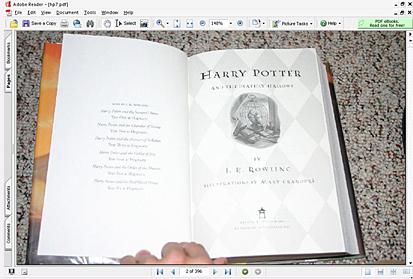
A few weeks back, Michael Moore's latest film, Sicko, was released and fared pretty decently at the box office, despite being available on P2P networks -- a situation one hyperbolic article described as "every film maker's worst marketing nightmare." That's a story that's played out time and time again, as the mere availability of pirated content hasn't held back the sales of legitimate content. Now, stories about the latest Harry Potter book being available on file-sharing networks are starting to come in, ahead of the book's release this weekend. This news isn't being met with the same level of media freakouts as when a reporter discovered Sicko online, with even the CEO of Barnes & Noble saying it "won't sell a single copy less" of the book despite it being available for free online. The biggest reason for this is the inconvenience of the pirated copies: they're huge PDFs, reportedly of low quality. To approximate the book-reading experience, users would have to print out all the pages, which could be time-consuming and expensive, while reading the book on a computer screen or monitor wouldn't be a lot of fun for many people. This draws parallels to other forms of piracy: for instance, while most new movies are available for free from file-sharing networks, plenty of people still want to pay to watch them in a theater, for a variety of reasons. Certainly there are people who will overlook any amount of drawbacks to get free content; chances are they wouldn't pay for legitimate content anyway. But there remains a large market of people who are perfectly willing to pay for content -- so long as content producers can provide them with sufficient value.

(Via Techdirt.)

Speaking of Secure Programming

A few months ago, while we were still in the thick of finishing off the book (Secure Programming with Static Analysis) and hadn’t yet started focusing on selling it, Brian and I recorded and interview with Informit’s new OnSoftware podcast where we talked about software security and the kind of material we cover in the book.


Well, months later the book is finished and now the interview we recorded is available for mass consumption through iTunes as either a video or audio podcast. You can subscribe to the podcast series on www.onpodcastweekly.com or link directly to our episode at http://media.podhoster.com/peachpittv/05_SOF_ChessWest_01.mp4.


Secure Programming with Static Analysis has gotten some nice attention from other sources, too. Gary McGraw recently posted the forward he wrote for the book on his Justice League security blog http://www.cigital.com/justiceleague/… and SANS has a nice interview with Brian up at http://www.sans.edu/resources/securitylab/brian_chess.php. I particularly like the part in the SANS interview where Brian takes credit for all the typos in the book ;-).

(Via Vaeros.)

Last Harry Potter leaks online

Cory Doctorow:
The new Harry Potter novel -- Harry Potter and the Deathly Hallows -- has hit the Internet days before its publication. The publisher spent a reported $20 million on keeping the book secret. Was the money well-spent? As Bruce Schneier points out, the kind of person who downloads a series of photos of the pages of a giant novel is also the kind of person who'll line up and buy a copy the night it comes out.

Me, I'm just glad to finally know what happens who dies at the end of the final Harry Potter novel -- SPOILER ALERT! Select the text below to read it.

The publishing industry.

Seriously, though. With the last book, the publisher was so freaked out about ebook "piracy" that they refused to release an official electronic edition. The result? Fans made their own electronic text in 24 hours. And other fans translated the book into German in 45 hours.

That'a a lot of fan-energy, sitting out there, looking for ways to love these books. Surely there's a smarter way to deal with that kind of love than attempting to suppress it?


Four days before it hits bookstores, I've got a copy of "Harry Potter and the Deathly Hallows." I downloaded it from a link posted at the Bittorrent file-sharing site the Pirate Bay.

But hold on. It's not as sweet as it sounds. What I've got is not really the book but a series of photographs of the book -- someone has meticulously snapped shots of each page. Some who've discussed leaked copies say that they've seen only Pages 1 through 495. But the copy I have includes all the pages; I could, if I wanted to, tell you the very last line of the very last Harry Potter book right now.


Link,
Link to Deathly Hallows torrents on The Pirate Bay

(Via Boing Boing.)

Neocons on a Cruise: What Conservatives Say When They Think We Aren’t Liste

Amazing story of a reporter who joined the crazy cruisers from the right wing nuts of "National Review". She starts with : "Is he your only child?" I ask. "Yes," she says. "Do you have a child back in England?" she asks. No, I say. Her face darkens. "You'd better start," she says. "The Muslims are breeding. Soon, they'll have the whole of Europe."

read more | digg story