
Out of Frame: Sweeney Todd

2007_12_21_sweeney.jpgWe've got a secret for you: Sweeney Todd is a musical. We understand there might be some confusion about that, seeing as how the television ads don't have a single note of singing in them, and if you blink during the theatrical trailer, you'll miss the five seconds of Johnny Depp singing buried in the clip. Make no mistake, though. The vast majority of this film is told in song. On the one hand, it's a shame that DreamWorks is acting ashamed of a musical as fun as Sondheim's, full of challenging, yet entirely accessible songs. But it's pretty clear that they're counting on scoring some extra ticket sales by luring in horror fans with playing up Tim Burton's dark, Gothic vision of the material. And that might be a smart move, because Sweeney Todd may just be that rare musical with broad appeal to audiences who might normally say they don't care for the genre.

Which is no surprise, considering that neither the film's director nor its star have much affinity for the genre themselves. Burton has crafted exactly the kind of musical he'd like to see, which is one that eschews big production numbers and full company set pieces in favor of a more naturalistic approach to the movie musical, if characters breaking into song can ever be considered naturalistic.

The story, which had been bouncing around in various forms for decades of British folk storytelling before Sondheim made it into an international musical sensation, is a fairly straightforward revenge tale: sweet natured barber Benjamin Barker is separated from his wife by a lustful judge who trumps up charges and sends him away for 15 years. Barker returns with a new name and bloodlust in his heart, but when vengeance is slow in coming, he turns his fury upon the hapless men sitting in his chair for a shave. His downstairs neighbor, Mrs. Lovett (Helena Bonham-Carter, playing the the character like a Cockney version of Fight Club's Marla), has a self-destructive taste for darkly mysterious psychopaths, and enters into a partnership with Todd to use the by-product of his murderous inclinations to supply her failing meatpie business. Hilarity ensues, just as in any of the many Broadway musicals concerning serial murder and cannibalism.


OK, so hilarity might be going a little far, but Burton does know when to let up on the overwhelming gloom for a few laughs. By taking the show off the stage and onto the screen, the director is able to infuse the affairs with as much blood, grime, and skin-crawl-inducing elements as the material really calls for (but which is largely impractical for live theater). Especially the blood. I lost count of the number of jugulars that are slit in the course of the movie, but there are many, and Burton shows the murders from many angles, with blood shooting, spurting and flying in all sorts of creative fashions. Few directors besides Dario Argento have ever taken this kind of operatic zeal in the display of gore, and it's not for the squeamish. As a result, without a sense of humor, the film would be a grim affair indeed. But Burton and screenwriter John Logan never fail to recognize the comic notes inherent in Hugh Wheeler's original book for the show. So they're sure to include the go-to comic ringer of the last few years, Sacha Baron Cohen, in a hilarious turn as a rival barber. And the "By the Sea" sequence, in which Mrs. Lovett fantasizes openly about a life of love and comfort with Todd into their golden years, is side-splittingly funny, as Burton throws all the vivid colors of his work on Big Fish around the still pale and dour Todd, making Lovett's fantasy all the more ludicrous.

Still, those moments are comic relief, and much needed relief from the darkest musical you're ever likely to see. Depp's Todd is a tortured character, not given to much talking. He talks less, in fact, than in the original musical. Burton again takes advantage of one of the differences between screen and stage by allowing Depp to play his part mostly through his eyes and his facial expressions. The reactions one can't see from the back of the house are readily apparent on the big screen, and Depp plays his wordless scenes with the skill of a seasoned star of silent film. Eyes flash and fade, brows furrow into an evil grimace, and even when he's pointedly ignoring the questions being asked of him by those around him, he speaks volumes.

Of course, he can't be silent all the time. So how's his singing? He's not likely to take Broadway by storm anytime soon, but its more than passable. The same goes for most of the cast, who are all better actors than they are singers, but in this context it works. Sondheim's score, re-orchestrated here to make it more lush and full, is still just as engaging and complex as it's always been. Sondheim purists beware, though: a few nips, tucks, and outright cuts were made to fit the long stage musical into a more manageable film version, and some are bound to be annoyed that there's a verse or a song missing here or there. But taken on its own, Todd is a rousing success. It's easily Burton's best film since Ed Wood, and one of Depp's best, most soulful performances. If you're iffy on musicals, don't let that scare you away: Burton sympathizes, and has made this musical with you firmly in mind.

Sweeney Todd is now playing at theaters all around the area.

(Via DCist.)
Amazon Patents Blurbs; Google Patents Snippets

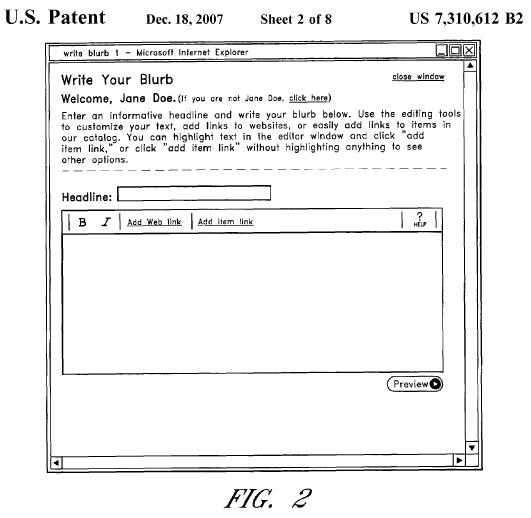
On Tuesday, Amazon.com was granted a patent for Personalized Selection and Display of User-Supplied Content to Enhance Browsing of Electronic Catalogs, which the three inventors note covers authoring and posting pieces of content, referred to as 'blurbs,' for viewing and rating by other users. The patent claims cover blurbs generated using a blurb authoring pipeline ('internal blurbs') as well as those obtained from external sources via RSS feeds ('external blurbs')." The details show that the patent is for personalizing these "blurbs," but it's difficult to see what's patentable here. Reading through the claims, there doesn't seem to be anything that's new here. All it's really doing is creating personalized blogs based on a combination of external blog content, catalog content and user reviews. In other words, it's aggregating a personal feed of content from a variety of sources. There are plenty of solutions out there that do this already -- it's just that they don't all refer to the content as "blurbs" as Amazon does, and they don't make it as explicit that it will include catalog content. But, aggregating content in a personalized manner is aggregating content in a personalized manner -- and it's been done by plenty of people well before Amazon bothered to patent the idea.
In the meantime, anyone else find it funny that Amazon has patented "blurbs" at about the same time that Google has patented "snippets"? Now wouldn't that make for an interesting patent infringement lawsuit? Google's patent appears to be about taking a document and coming up with an automated summary "snippet" that can be displayed with search results. Again, it seems like a stretch that this should be patentable, but the patent office clearly feels differently. So, let's see... if both blurbs and snippets are patented, what's next? Clips? Who wants to patent clips? Yahoo? Microsoft? eBay? Anyone?

Perino On CIA Tapes: ‘Nothing I Have Said Has Been Contradictory’ — Just Evasive

After the White House complained about a “subheadline” in today’s New York Times — which read “White House Role Was Wider Than It Said” — Dana Perino announced that the paper would “retract that headline, and they are going to run a correction tomorrow.”


At today’s press briefing, the White House press corps bombarded Perino with at least 20 questions on the issue of whether the White House had previously acknowledged the involvement of other staffers in the destruction of the CIA tapes. Perino argued the Times story was “saying that I had misled the American public on this. And I have not. There is nothing I have said that has been contradictory.” Watch it:


Screenshot


Perino may not have been contradictory, but she has been evasive, repeatedly refusing to address the White House’s role. For example, when asked on Dec. 7 whether there was “any White House involvement in approving or commenting upon” the tapes destruction, Perino responded that she “couldn’t answer”:


Q: Was there any White House involvement in approving or commenting upon their destruction?


MS. PERINO: As I said, the President has no recollection knowing about the tapes or about their destruction, and so I can’t answer the follow-up.


In today’s briefing, CNN’s Ed Henry pointed out that the White House has privately been telling reporters that it was urging the CIA not to destroy the tapes:


In fact, right after the story first broke, people within the administration did say privately that, in fact, Harriet Miers had told the CIA not to destroy the tapes, and that that suggested that the White House, in fact, was saying, Don’t destroy. Now, this New York Times story is saying four people in the president’s or vice president’s inner circle actually talked to the CIA about it. So that does suggest a wider role.


Perino countered that she is “not accountable for all the anonymous sources that you turn up.” And yet, the media pursues anonymous sources because Perino continues to be evasive about the role of White House staffers in the destruction of the tapes.


UPDATE: Steve Benen writes that the White House response is missing the big picture: “After we learned about the torture tapes, the official White House line was that Bush’s lawyers urged the CIA not to destroy the videos. … And now the NYT has spoken to some officials who insist Bush’s lawyers actually did the opposite.”


UPDATE II: Dan Froomkin suggests, “The best indicator of how seriously this White House is involved in a political scandal may be how emphatically it refuses to comment.”

(Via Think Progress.)

NYT Changes Subhead After Perino's Bitching [Dana Perino]

i will not comment on how much i fucking hate the NYTAfter the White House released a statement lambasting the New York Times for a freaking sub-headline, the NYT has decided to play the bigger man by changing it online and issuing a correction. The controversial headline — “White House Role Was Wider Than It Said” — has been replaced with “Bush Lawyers Discussed Fate of Tapes.” As the Times’ DC editor told Politico, however, “If they want to quibble with the deck, they have a legitimate point. But nobody is raising any questions with what the story is about, and what the story said.” Indeed, and now probably twice as many people have read the damning story. So Dana Perino continues to be a dumbshit, and the world is as it was.

(Via Wonkette.)

Shocker: White House Pissed at NYT [Dana Perino]

no homoDana Perino, you icy chamberpot of talky talky death! Only one day after your pals Blackwater shot the New York Times’ fucking dog, and you’re releasing a statement condemning its headline this morning? For being misleading? You, the White motherfucking House is calling someone else misleading? If you weren’t so damn pretty, I’d curse you out several more times.

Indeed, Dana Perino had no sympathy for the precious murdered pup Hentish this morning. Instead, she released an extensive statement condemning the NYT’s story on the White House’s involvement in destroying those CIA tape things:

The New York Times today implies that the White House has been misleading in publicly acknowledging or discussing details related to the CIA’s decision to destroy interrogation tapes.

The sub-headline of the story inaccurately says that the “White House Role Was Wider Than It Said”, and the story states that “…the involvement of White House officials in the discussions before the destruction of the tapes…was more extensive than Bush administration officials have acknowledged.”

Under direction from the White House General Counsel while the Department of Justice and the CIA Inspector General conduct a preliminary inquiry, we have not publicly commented on facts relating to this issue, except to note President Bush’s immediate reaction upon being briefed on the matter. Furthermore, we have not described - neither to highlight, nor to minimize — the role or deliberations of White House officials in this matter.

The New York Times’ inference that there is an effort to mislead in this matter is pernicious and troubling, and we are formally requesting that NYT correct the sub-headline of this story.

It will not be surprising that this matter will be reported with a reliance on un-named sources and individuals lacking a full availability of the facts — and, as the New York Times story itself acknowledges, some of these sources will have wildly conflicting accounts of the facts. We will instead focus our efforts on supporting the preliminary inquiry underway, where facts can be gathered without bias or influence and later disseminated in an appropriate fashion.

We will continue to decline to comment on this issue, and in response to misleading press reports. (emphasis ours)

So now she’s gloating about her widespread “no comment” policy, rather than viewing it as a source of embarrassment? Usually you want to bring out an “oh snap” with a direct statement like this, and that requires providing new information. Give it up reporters! “No comment” is the new American foreign policy, and all rogue commenters will be frozen or have their dogs shot.

Dec. 19 Statement by the Press Secretary [White House]

(Via Wonkette.)

Columnist: Microsoft could learn from Apple's Family Packs

Newsflash: Microsoft messed up. Yes, I know, that doesn't come as news to most of you (that's why you're here), but Joe Wilcox over at eWeek was surprised by the fact that while Apple's Leopard Family Pack pricing lead to some nice sales numbers, Microsoft instead decided to discontinue their family pack prices. Basically, you could buy OS X 10.5 as a single copy for $129, or a "family pack" (installations for 5 Macs) for $199. And a whopping 33% of Leopard sales were of the family pack version, even though OS X doesn't require any validation at all-- users could just have bought the $129 version and installed it five times.
What's the difference? Wilcox says that Apple trusts their customers, and as a result, users who feel the family pack is worth it are willing to pay. Microsoft, on the other hand, demands validation from their users. Wilcox also quotes an analyst (which in this case is Latin for "he who states the obvious") saying that Leopard had a blowout launch, much better than Vista. But that's a big duh, so I won't even bother comparing OS X to Vista-- I'll leave that to the Mac commercials.

What else do you need to know? Clearly, Microsoft is just plain doing it wrong.

Read

(Via TUAW.)