Flame First, Think Later: NYT on why we act like jerks online

Xeni Jardin:


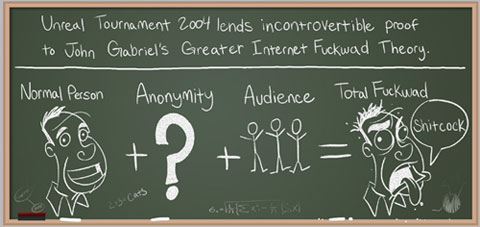
Image: Penny Arcade.

This New York Times story on the psychopathology of flame wars has -- surprise! -- generated much heated discussion around the internet:

John Suler, a psychologist at Rider University in Lawrenceville, N.J., suggested that several psychological factors lead to online disinhibition: the anonymity of a Web pseudonym; invisibility to others; the time lag between sending an e-mail message and getting feedback; the exaggerated sense of self from being alone; and the lack of any online authority figure. Dr. Suler notes that disinhibition can be either benign — when a shy person feels free to open up online — or toxic, as in flaming.


Over on Metafilter, user scblackman rounds up links to some related web references:

What's behind those flaming hot e-mails or UseNet flame wars or MetaFilter comments?. Perhaps, as John Suler suggested, there are a number of factors, including dissociative anonymity, invisibility, asynchronicity, solipsistic introjection (altered self-boundaries), dissociative imagination, and minimzation of authority, as he discussed in his fascinating 2004 paper.

Link to that MeFi thread, in which several commenters said the NYT article reminded them of the timeless comic above.

(Via Boing Boing.)

Second Life: Drew from “Toothpaste for Dinner” tries it.

Xeni Jardin:


Drew, the Columbus, Ohio-based creator of the offbeat webcomic Toothpaste For Dinner, recently tried out Second Life. Drew being Drew, he had this to say:

Yesterday I downloaded something called Second Life. It is like Grand Theft Auto: San Andreas, except you can't shoot anyone, and you can't hit people. You just walk around. There are no prostitutes, and everything costs real money, and you can't rob anyone to get money. You have to use your credit card, with real money, to buy fake money to use in the game. It's not actually like Grand Theft Auto at all.

Second Life is free to play, and I keep seeing people referring to it in the news, so I had to take one for the team and just dive on in. I knew it probably wasn't going to be intriguing when I got to the signup part and couldn't even make a one-word name. I had to use some fantasy-ass last name and I couldn't even use cusses. The best I could do was call myself Wenis.

Wenis Swindlehurst: How do I hit people

Foxbrand Leprechaun: You can't

Wenis Swindlehurst: I need that shit you drive.


My character came pre-loaded as a "cybergoth". Most people I saw in the game, jerkily wandering around, also had fantasy-ass names. They also had fantasy asses. Perfect, round fantasy asses. Which left me with only one choice: I had to become what they were not.

Link to the full text of Drew's post. (Thanks, Michael Varrenti)

(Via Boing Boing.)

Penny Arcade: A rare opportunity

Gabe: Yesterday I made a post about the teenagers that murdered the homeless guy and then blamed it on violent games. These kids have given the media their angle and just like all the other cases where games are mentioned no one will ever look any further. No one will ask what their family life was like, what their parents were like, what the kid was like before all this happened. Games did it and that"s the end of the story.

(Via Penny-Arcade.)

Coinstar hackers trick machines into waiving 9% fee

Xeni Jardin:
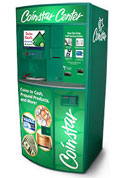
Link to the description of a pretty simple method by which Coinstar machines can reportedly be compromised into counting spare coins, without charging the user Coinstar's standard 9% transaction fee. I'm fairly certain this may not be legal, and it's posted here for technical analysis purposes only. (via, thanks Andrew)

Reader comment: Gabe says,

Your mileage will vary on the Coinstar trick. A few weeks ago I dumped $60 worth of coins into my local Coinstar and selected the "Starbucks Card" option. The system spun for a few minutes trying to connect (I did not pull the phone cord; I really wanted a Starbucks card), and then dumped me to a screen saying my selected option was unavailable. It prompted me to try another. I tried a few other options (Amazon gift certificate, iTunes card), and they all failed.

Kurt says,

If you live in NYC, Long Island, CT, NJ, or the Palm Beach area of FL, Commerce Bank has coin machines that are 100% free. You don't have to do anything potentially illegal, and you don't even have to have an account at the bank. I go there all the time to dump off my coins. And their coin machine is awesome, it has a video screen with Penny from Pee Wee's Playhouse, who counts your change while you pour it in.

David says,

Back in 2004, the Wall Street Journal tested Coinstar and other similar machines, and found them all to be inaccurate, especially the "100% free" Commerce Bank machine:

"For consistency, we began with equal piles of $87.26 worth of pennies, nickels, dimes, and quarters that we had gotten from a local bank in coin envelopes. Talk about a tough economy. The machines at both Commerce Bank and Coinstar gave us less back than we put in -- Commerce Bank missed by a whopping $7.02, while Coinstar was off by 57 cents."

The article is on-line but it's subscriber-only. The link, for those with access, is here

.

Brad says,

One way to legally enjoy fee-free Coinstar services, albeit not all in cash, is to make a legitimate attempt to put the amount on one of their gift cards - every machine I have tried has choked at this point, and the machine is programmed to eventually just print out a voucher. In every case, the transaction fee has been included.

I have emailed Coinstar about this problem each time it's happened (making sure to include the transaction ID off the voucher) and in every case, they have responded within 24 hours with a credit for the fee applied to my Starbucks Card. Using this method, you'll get 91% in cash and 9% on your Starbucks Card - not a bad exchange, really.

(Via Boing Boing.)