
Vista Suicide Note — rebuttal and response
Cory Doctorow:
Peter Gutmann, author of the "Vista Suicide Note" paper (in which he added up the cost of implementing all the dumb DRM in Vista), has responded to Microsoft's answer to his paper, in which they tried to spin the issue to make it all seem harmless. As with the original paper, the response is savage, funny, and fact-filled:
"Do things such as HFS (Hardware Functionality Scan) affect the ability of the open-source community to write a driver?
"No. HFS uses additional chip characteristics other than those needed to write a driver. HFS requirements should not prevent the disclosure of all the information needed to write drivers. "
This claim is directly contradicted by a document by the same author which states:
"Such tests could involve loading a surface with an image, and then getting the chip to apply various visual effects to the image and reporting back the resulting pixels. "
and then later on:
"The internal workings of the graphics chip must be kept secret, such that a hacker building an emulator could not find out the required information."
So this document, the primary reference for Vista's content protection, states exactly the opposite of what's said in Microsoft's response, namely that standard chip functionality (in this case graphics rendering in a GPU) is exercised for HFS, and that the device details have to be kept secret to prevent someone emulating the functionality.
(via Pwned)
(Via Boing Boing.)

Scary “prehistoric” shark caught on video
David Pescovitz:
Researchers at the Awashima Marine Park south of Tokyo videotaped this scary frilled shark this week. Frilled sharks, Chlamydoselachus anguineus, are rarely seen alive because they live at depths of 600-1000 meters. This specimen was spotted by fishermen in shallow water. Sadly, it died a few hours after the Marine Park staff moved it to a seawater pool where the video was captured. From Reuters:
Marine park staff caught the 5 foot (1.6 meter) long creature, which they identified as a female frilled shark, sometimes referred to as a "living fossil" because it is a primitive species that has changed little since prehistoric times...
"We think it may have come close to the surface because it was sick, or else it was weakened because it was in shallow waters," the official said.
Link (Thanks, Jennifer Lum!)
Previously on BB:
• Video: Indonesian coelacanth Link
• New Waspfish species Link
• Victim of the cookie cutter shark Link
(Via Boing Boing.)
McCain falls asleep
during the State of the Union?
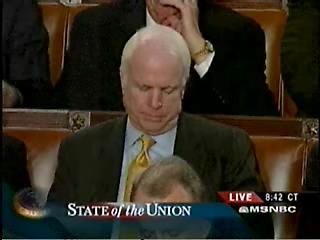
MSNBC’s Tucker Carlson:
If you’re McCain, who will be over 70 by 2008, you’ll want to make doubly sure to demonstrate your alertness and vigor. You definitely won’t want to slump in your seat, out cold, when Bush starts talking about Iraq. And yet that’s exactly what McCain did tonight, napping on camera for ten agonizing seconds. Lack of self-control? An expression of contempt? Embarrassing in any case.
(Via Think Progress.)
Webb: If Bush Doesn’t Take The ‘Right Kind Of Action…We Will Be Showing Him The Way’
In his response to the State of the Union, Sen. James Webb’s (D-VA) offered a harsh criticism of President Bush’s national security and economic policies. He said that Bush “recklessly” took the country into war with Iraq, ignored the advice of his top advisers, and is now holding the nation hostage in the war’s “predictable — and predicted — disarray.” Watch it:
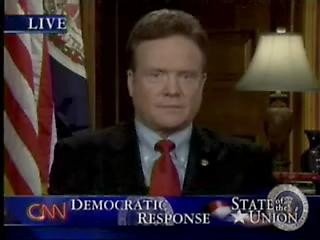
Webb also compared the current situation of economic disparity in the United States to the era of when “robber barons were unapologetically raking in a huge percentage of the national wealth” and the “dispossessed workers at the bottom were threatening revolt.” Like Theodore Roosevelt, Bush now needs to take the “right kind of action” for “the benefit of the American people.” Webb concluded, if Bush chooses a new direction, “we will join him. If he does not, we will be showing him the way.”
The President took us into this war recklessly. He disregarded warnings from the national security adviser during the first Gulf War, the chief of staff of the army, two former commanding generals of the Central Command, whose jurisdiction includes Iraq, the director of operations on the Joint Chiefs of Staff, and many, many others with great integrity and long experience in national security affairs. We are now, as a nation, held hostage to the predictable — and predicted — disarray that has followed.
The war’s costs to our nation have been staggering. Financially. The damage to our reputation around the world. The lost opportunities to defeat the forces of international terrorism. And especially the precious blood of our citizens who have stepped forward to serve.
The majority of the nation no longer supports the way this war is being fought; nor does the majority of our military. We need a new direction. Not one step back from the war against international terrorism. Not a precipitous withdrawal that ignores the possibility of further chaos. But an immediate shift toward strong regionally-based diplomacy, a policy that takes our soldiers off the streets of Iraq’s cities, and a formula that will in short order allow our combat forces to leave Iraq.
On both of these vital issues, our economy and our national security, it falls upon those of us in elected office to take action.
Regarding the economic imbalance in our country, I am reminded of the situation President Theodore Roosevelt faced in the early days of the 20th century. America was then, as now, drifting apart along class lines. The so-called robber barons were unapologetically raking in a huge percentage of the national wealth. The dispossessed workers at the bottom were threatening revolt.
Roosevelt spoke strongly against these divisions. He told his fellow Republicans that they must set themselves “as resolutely against improper corporate influence on the one hand as against demagogy and mob rule on the other.” And he did something about it.
As I look at Iraq, I recall the words of former general and soon-to-be President Dwight Eisenhower during the dark days of the Korean War, which had fallen into a bloody stalemate. “When comes the end?” asked the General who had commanded our forces in Europe during World War Two. And as soon as he became President, he brought the Korean War to an end.
These Presidents took the right kind of action, for the benefit of the American people and for the health of our relations around the world. Tonight we are calling on this President to take similar action, in both areas. If he does, we will join him. If he does not, we will be showing him the way.
Thank you for listening. And God bless America.
(Via Think Progress.)
Gold-farmers’ trade association
Cory Doctorow:
Korean "gold-farmers" (people who accumulate and sell in-game wealth) have formed a trade-association in order to lobby the government for better treatment. Gold-farmers sometimes just play a lot of games to get their items, but many use "cheats" like scripts that exploit bugs to accumulate wealth, or even hire sweatshops full of people to do the repetitive busy-work for them (something I explore in my story Anda's Game, which appears in Overclocked, my new collection).
This is embarrassing — the gold farmer and RMT companies in Korea, such as ItemBay and Item PlayForum, have formed an industry association in order to have more leverage with the Korean government, given its recent moves towards regulating digital asset trading. This means, I think, that they beat the actual game companies to it. It’s called the “Digital Asset Distribution Promotion Association,” and the CEO of ItemBay will be its first head.
(Via Boing Boing.)
Sen. “Series of Tubes” Stevens introduces DOPA II: the sequel
Xeni Jardin:
Andy Carvin says,
It didn't take long for at least one member of Congress to reintroduce legislation aimed at further restricting Internet access at schools and libraries. As reported by ZDNet and Linda Braun of the ALA, Sen. Ted Stevens of Alaska has introduced what they describe as "identical language" to DOPA, the Deleting Online Predators Act of 2006. If DOPA had become law, it would have forced schools and libraries receiving E-Rate subsidies to block access to commercial interactive services, including online social networks and blogging tools. But the bill expired when the Dems took over Congress.
Stevens re-introduced the bill the first day of the new session, and he added some new twists to it, according to ZDNet:
"Stevens didn't stop there, packaging his reincarnation of DOPA with another failed proposal that would require all sexually explicit sites to be labeled as such, according to a copy of the bill obtained by CNET News.com. Although it has encountered opposition from civil libertarians, the idea gained bipartisan support within Congress, passing unanimously as an amendment to a massive communications bill that ultimately died."
From what I can tell, DOPA Jr. doesn't have a title yet, nor any cosponsors, though it's referenced as Senate Bill 49, or S. 49. The Library of Congress hasn't posted the text of the bill yet, but it has this brief summary:"Title: A bill to amend the Communications Act of 1934 to prevent the carriage of child pornography by video service providers, to protect children from online predators, and to restrict the sale or purchase of children's personal information in interstate commerce."
Link to post on Andy's personal blog, and here's an updated post he wrote for a PBS blog he authors: Link.
Previously:
Reader comments: Gorc Kat says,
"..and to restrict the sale or purchase of children's personal information in interstate commerce." Personally, I welcome that snippet- imagine the sudden influx of 13 year olds to websites that previously sold users info to ad companies. Like Peter Pan, I'll be a boy forever!
(Via Boing Boing.)